Boulder vs Block Retaining Walls: Which Is Right for Your Utah Property?
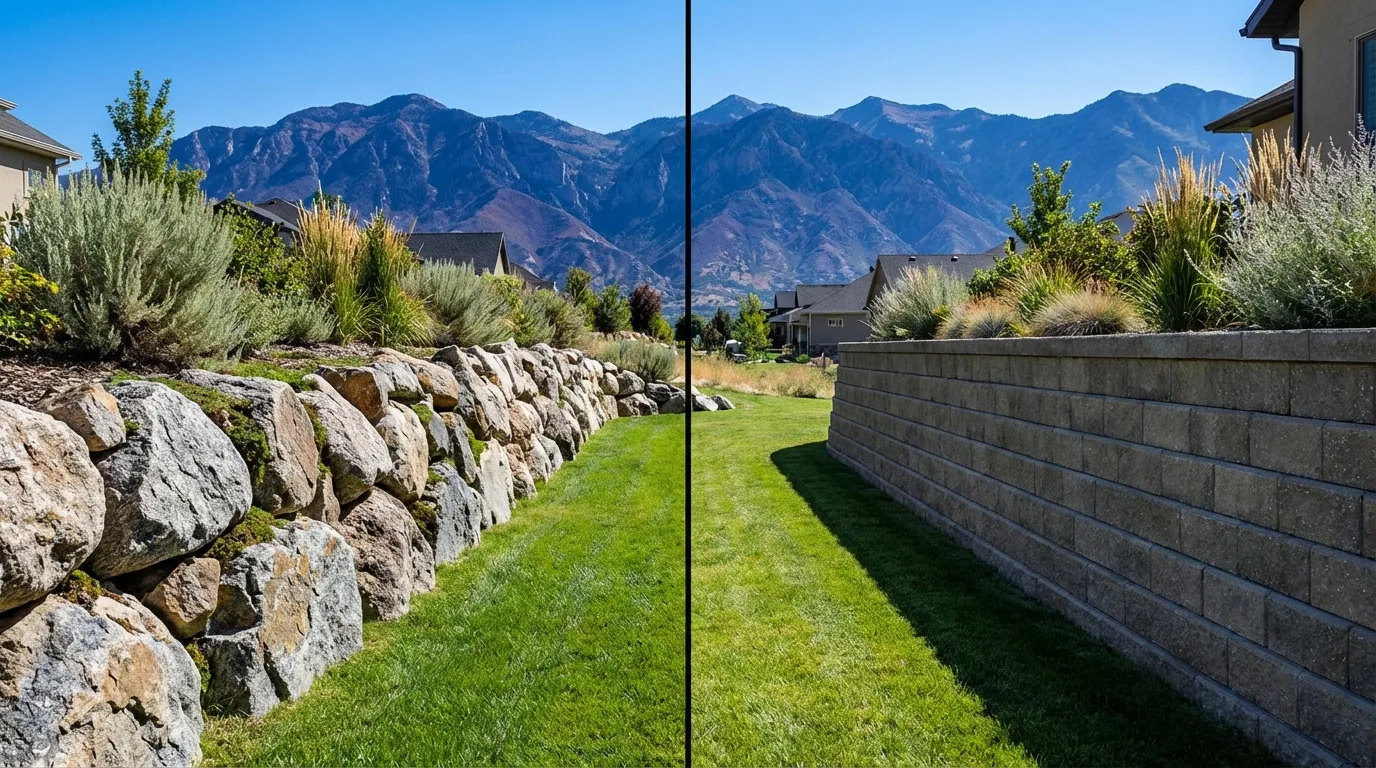
When planning a retaining wall in northern Utah, the material choice matters as much as the engineering. The two most popular options — natural boulder walls and concrete block (segmental) walls — serve the same purpose but differ in appearance, installation, and performance.
Here’s an honest comparison to help you decide.
Natural Boulder Retaining Walls
Boulder retaining walls use large natural stones stacked and positioned to retain soil. They’re a Utah classic, especially along the Wasatch Front where natural rock is abundant.
Advantages
- Natural appearance — Blends seamlessly with Utah’s mountain landscape
- Local material — Utah granite, sandstone, and basalt are readily available, which can reduce material costs
- Durability — Natural stone doesn’t fade, chip, or deteriorate like manufactured products
- Low maintenance — No sealing, painting, or replacement of individual units needed
- Character — Every boulder wall is unique; no two look alike
Considerations
- Requires heavy equipment — Boulders weigh hundreds to thousands of pounds and need excavators or loaders to place
- Less precise — Natural stone doesn’t stack as uniformly as manufactured block
- Height limitations — Boulder walls work best under 6 feet; taller walls may need engineering modifications
- Site access — Heavy equipment needs room to maneuver; tight spaces can be challenging
Best For
- Properties with natural landscaping or mountain views
- Rural and semi-rural lots with good equipment access
- Homeowners who want a rustic, organic look
- Shorter to mid-height walls (2-5 feet)
- Erosion control on slopes with natural terrain
Concrete Block Retaining Walls
Concrete block walls use manufactured interlocking units (like Allan Block, Versa-Lok, or Pavestone) that stack together in a controlled, engineered system.
Advantages
- Engineered precision — Manufactured to exact specifications with built-in setback angles
- Height capacity — Block systems can be engineered for very tall walls (10+ feet with proper reinforcement)
- Design options — Multiple colors, textures, and cap styles available
- Tight spaces — Can be installed without heavy equipment in some cases
- Geogrid reinforcement — Block systems integrate easily with geogrid for added structural capacity
Considerations
- Manufactured look — Even high-quality block can look uniform compared to natural stone
- Color fading — Some block products fade over time with UV exposure
- Material cost — Manufactured block can be more expensive per square foot than local boulders
- Availability — Specific colors or styles may need to be ordered and have lead times
Best For
- Clean, modern landscape designs
- Tall walls requiring significant engineering
- Properties with limited equipment access
- Walls adjacent to driveways or structures needing precise dimensions
- Commercial projects requiring uniform appearance
How Utah’s Climate Affects Your Choice
Northern Utah’s freeze-thaw cycles, clay soils, and dry summers impact both wall types:
Freeze-Thaw Performance
Both materials handle Utah winters well, but the approach differs:
- Boulders — Natural stone is extremely freeze-thaw resistant. Gaps between boulders allow water to drain freely.
- Block — Quality manufactured block is rated for freeze-thaw cycles, but proper drainage behind the wall is critical to prevent frost heave.
Drainage
This is where many retaining walls fail in Utah. Our clay-heavy soils hold water, creating hydrostatic pressure behind walls. Both wall types need:
- Perforated drain pipe at the base
- Gravel backfill behind the wall
- Proper drainage solutions to direct water away
Boulder walls have a slight advantage here — the natural gaps between stones act as weep holes, allowing some water to pass through. Block walls rely entirely on the designed drainage system.
Soil Movement
Utah’s expansive clay soils swell when wet and shrink when dry. This seasonal movement can affect wall foundations. Both wall types need footings that extend below the frost line (36 inches in most of Weber and Davis counties) and sit on stable, compacted subgrade.
Can You Mix Both Materials?
Yes — and it often looks great. Some of our most popular projects combine a structural block wall with boulder accents, or use boulders for the main retaining function with block for decorative terracing above.
This hybrid approach gives you the structural benefits of engineered block where you need height and precision, plus the natural beauty of boulders where aesthetics matter most.
Frequently Asked Questions
Which type of retaining wall lasts longer in Utah?
Both last decades when properly built with adequate drainage. Natural boulder walls have a slight edge in longevity since stone doesn’t degrade, but a well-constructed block wall with quality materials will easily last 50+ years.
Can I build either type as a DIY project?
Short block walls (under 2 feet) are manageable for experienced DIYers. Boulder walls require heavy equipment and are not realistic DIY projects. For any wall over 3 feet, we recommend professional installation — the cost of fixing a failed wall far exceeds the cost of building it right.
Which retaining wall type is better for resale value?
Both add significant value. In neighborhoods with natural landscaping (common in Ogden, Eden, and Huntsville), boulder walls often blend better. In newer developments with manicured yards, block walls may appeal more to buyers. Either way, a professionally built retaining wall is a strong selling point.
Not sure which material is right for your property? Ogden Rock Walls builds both boulder and block retaining walls throughout northern Utah. We’ll assess your site and recommend the best solution. Call (385) 312-0606 or get a free estimate.